61st Florida Folk Festival

Last year was my first year vending at the 60th Florida Folk Festival. My sister, Betsy, braved excessive heat, voracious ticks, all night music jams and primitive camping at the Florida State Park Stephen Foster Cultural Center for three nights and four days. A Sunday afternoon thunder and lightning storm closed the festival down early.

This Memorial Day Weekend I’ll be vending at the 61st Florida Folk Festival alone. I feel honored to have been invited back. Betsy won’t be attending with me however. This year she’s taking my 90 year old father to a wedding on Saturday afternoon. Not hers. Or his. Perhaps she’ll drive three hours each way to attend the festival on Sunday. She says she wants to.

Last year Betsy was useless when it came to demonstrating my wares. She couldn’t even get seashell pasta to squeak, let alone make a loud whistle sound. But that’s OK because she stayed at my booth while I used the restroom or got a bite to eat. She smiled and chatted with people and let them know I’d be right back. That’s invaluable for a solo vendor like me. And she was/is great company.

Ray Wood is a Native American Flute Maker. And even though he’s not Native American  he takes his craft very seriously. He makes beautiful sounding and looking wood and bamboo flutes. Ray has been my vending coach/brother/mentor since I began vending at Native American Flute festivals and other Florida music festivals. He was and still is very strict. In the beginning I tended to wander away from my booth in order to catch performers or talk with other vendors. Ray reeled me in, saying it was my responsibility to be at my booth during business hours.

Ray believes everyone has a unique purpose or mission in life. As I understand him he believes his mission is to be there for people searching for their higher purpose in life. He does this by showing them the beauty he has found in flute making and in the playing of his instruments. Ray doesn’t use music notation to play by. He advises people to follow their heart and feelings to make and play music. He tells people his story. Some get it. I bought my first NAF flute from Ray a few weeks ago. Thanks Ray. I get it.

I have no idea what my higher purpose in LIFE is, regarding my discoveries concerning seashell spiral flutes. I stumbled upon these discoveries and I’ve enjoyed bringing them to the market place. I’ve met wonderful vendors/mentors and have marveled at the skills and luck necessary to create successful businesses. I’m still working to create a successful business. Ray is inspiring me. Thanks Ray. I’m working on it.

When people ask me how I discovered my seashell flutes I tell them the story about how I learned to whistle with an acorn cap, in PA, from my nephew, Jon, and how I transferred that skill to a seashell (small clam shell) during a Florida vacation in 2003 because I wanted to communicate with wild dolphins. The dolphins whistled back and the rest is history. I went to a Florida shell shop, tested a bunch of shells for sound making capabilities, took them back to Cape Cod, and discovered the musical scales inside three different species of seashells.

Notes of interest, at least for me, is that these seashell species haven’t changed their shapes for 65 (more or less) million years.  That means that the capability to express the pentatonic, diatonic and chromatic musical scales has been available and accessible on earth for 65 or so million years. That means that the musical scales are natural and very old indeed. Not invented or created by MANKIND.

Thanks for reading my blog.  More to follow.

seashell musical spirals

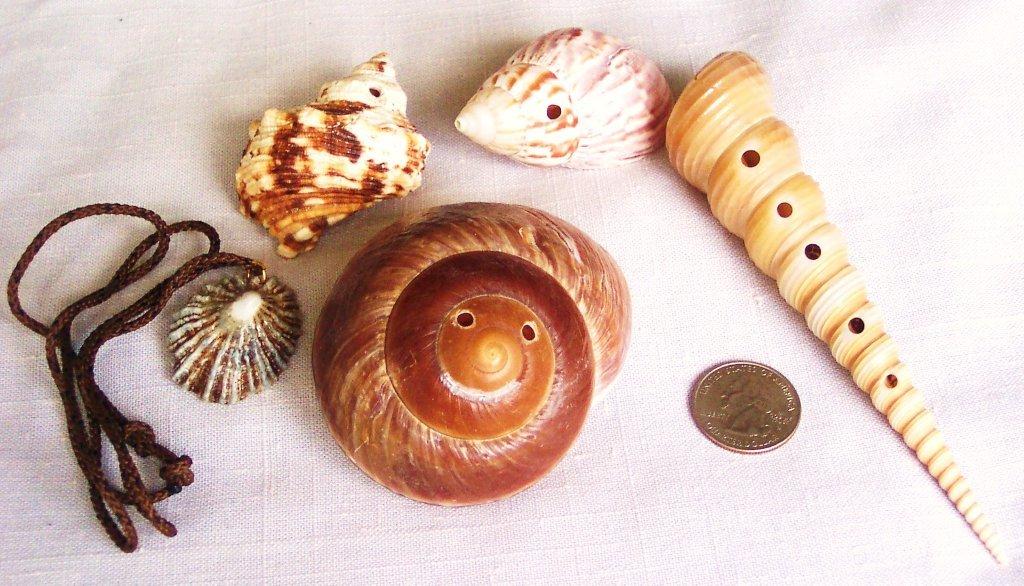
These are seashell musical spirals.

The Turritella Shell contains the ability to release the chromatic, diatonic and pentatonic musical scale of notes in all keys between A and F.

The size of the shell determines the key. Bigger and longer is deeper;  smaller and shorter is higher. I don’t know why the key of G is unavailable. Maybe that’s God’s Key…………..

A straight line of five finger pitch holes drilled into whorls 2, 3, 4, 6 and 8 releases an octave and a half of musical notes. This shell’s common name is the Screw Shell because it looks like a large brown wood screw. I call the instrument the Screw Shell Flute.

The Rysotta Ovum Shell contains the ability to release the diatonic and pentatonic musical scale of notes. More research is needed to discover all the Keys that are available.

Finger pitch holes are drilled into the shell’s whorls following X/Y coordinate lines centered on the shell’s spiral apex or beginning. Up to five finger pitch holes can be drilled. These release five, six and seven diatonic notes. The notes are deeper sounding than the notes produced by the Turritella Shell Flutes.

The common name for this shell is either the Muffin Shell or Cinnamon Bun Shell because that’s what it looks like I suppose. So I call this instrument the Muffin Shell Hoot. They really do sound similar to large owl calls.

I’ve examined many shells during the ten years I have been researching this phenomenon. Only two species release musical scales of notes. Only one contains the ability to release enough chromatic, diatonic and pentatonic musical notes to play most tunes and songs that have ever been enjoyed by human beings.

These are seashell musical spirals. They’ve been here for over 250 million years.

once in a blue blue moon

Last night I attended the Full Moon Drum Circle at the Dandelion Cafe in Orlando, Fl. This small circle is generous; the participants always bring a variety of acoustic instruments for self and group expression. And it’s not an instrument’s fault if a discordant note is occasionally heard. The most pleasing key at this circle, at least to my ears, is B.

Last night I heard a woman play a crystal bowl. She tapped it’s side four times, then round and round the rim she, with stick, did rub. The bowl began to sing, softly at first, then loud and clear, like a bell’s chime without end. I played along with this glorious sound; a crystal drone for Londonderry Aire, Loch Lomond and a host of Celtic melodies that seemed to dance from my flute.

Last night I played a seashell flute in the Key of B. I make seashell flutes in the keys of B, C, D and sometimes E. The length of the shell’s spiral tube determines the key the flute is in. At length I asked what key her bowl was in, expecting her to say B. She, instead, said F.

B, C, D, E, F– five notes separate our instruments; a perfect fifth. I never knew what that really meant until last night. It means perfect harmony. My seashell flute, in the key of B, was incapable of playing discordant notes with her crystal bowl. I played with passion; first softly, then loud and clear. She tapped her bowl in time with my tunes, adding her own rhythmic chimes to the ethereal sounds of seashell flute, crystal bowl and drums.

thumbouchure

Acorn caps can be used as whistles, if you know how to do it. In North America both thumbs are used. In Europe, only the index and middle finger of one hand are used. No one knows when or where this arcane and obscure skill originated or why there are two different styles of whistling with acorn caps.

I am thankful that I learned the North American style first because once I applied the skill to small seashells my fingers were free to wrap around shell bodies. I drilled pitch holes into logarithmic spiral shells, under where my finger tips touched the shell whorls and found the musical scales, but that’s another story told elsewhere throughout  this blog.

I call the ‘acorn cap whistle skill’ thumbouchure. It is the way both thumbs are used to cover and seal the opening of a shell or other concave object and create a mouth hole through which the player’s breath is directed to strike the object’s rim in order to resonate the air inside the shell and make sound.

There are two North American thumbouchure positions. The size of the object or shell instrument opening (aperture) relative to the width of the players thumbs determines which position will be used.  The first (standard) thumbouchure position is used with small shell openings (1/4″ – 2″ wide) and is made as follows:

make two fists with thumbs on top. Bring both fists evenly together so that the thumb joints of each hand are pressed evenly together. With thumbs still touching separate both fists a few inches apart, like your thumbs are hinged. You will now be looking at the back of each fist. Push thumbnails evenly apart to form a wedge shaped opening above the thumb joints. This wedged shaped opening is called the wind way. Thumbs stay pressed together below the wind way.

The second position is used with larger shell openings (2″ – 4″) and is made as follows: same as standard thumbouchure position except separate the thumbs at the second joints to create the wind way. An alternate way to do this that allows the fingers of the right hand to more easily touch the shell body is to press the right thumb joint against the left thumb knuckle (second thumb joint) The meaty part of the left thumb will be used to cover and seal three quarters of larger shell openings. The right thumb will cover the remaining area of the opening and make the wind way.

Once the shell or concave object has been positioned under the thumbs using the first or second thumbouchure positions it is time to place the lips on the thumbs and blow breath through the wind way.

The wind way is the area at the bottom of the wedged shaped opening created by the parted thumbs. Keeps your lips soft and shaped like you’re saying the word ‘who’. Press both lips onto your thumbs so that the breath exits the mouth only from under the upper lip. The bottom lip is pressed onto the thumbs a bit below the wind way.The breath strikes the exposed rim of the object and resonates the air inside the object.

The smaller the object the faster the breath needs to be. Puff the cheeks out and blow forcefully when using small objects such as acorn caps, bottle tops, small clam shells or other small shells, thimbles or hard uncooked seashell pasta. Blow gently for larger objects. Make adjustments until you hear sound. Thumbouchure creates rim blown whistles out of many manufactured and naturally occurring objects. Have fun. Enjoy!

Mother of Music

Most small and empty univalve seashells encase spiral columns of air space that can be resonated to produce sound. The shell, Terebra Turritella, commonly known as the Screw Shell or Unicorn Shell, encases a conical helix air space. Experts report that Its shape has remained the same since the Jurassic Period.

The first eight whorls, counting from the shell opening (aperture) to the pointy end (apex), are hollow. After that the whorls are solid to the shell apex. A whorl is one revolution of the spiral. If one draws a lengthwise center line on the shell, one spiral revolution begins on the line and ends on the adjacent whorl line, either above or below the starting point.

The air space inside one spiral revolution of the Terebra Turritella shell increases or decreases in volume logarithmically. Diatonic musical notes also increase or decrease in pitch logarithmically. In the case of the Terebra Turritella shell the spiral logarithmic air space contains the logarithmic diatonic musical scale potential. Another way of saying that is the diatonic musical scale is dormant within the first eight whorls of theTerebra Turritella shell.

The Terebra Turritella shell releases the diatonic musical scale of notes when five pitch holes are drilled into whorls 2, 3, 4, 6 and 8, following the lengthwise axis line of the shell. The logarithmic shape of the shell’s air space corresponds to and contains the diatonic scale of notes. In fact, an octave and a half of diatonic and chromatic notes are available.

No mathematical measurements or calculations are required or necessary to create this musical instrument. All other musical instruments in the world, capable of releasing the pentatonic, diatonic and chromatic scales of notes, require the use of mathematical calculations or measurements in their construction.

The Turritella Shell Flute is a primal and natural musical instrument. I consider it to be the Mother of Music and Musical Instruments. It’s spiral shape, along with the five pitch holes, releases an octave and a half of pentatonic, diatonic and chromatic notes. The shell contains all the mathematical calculations required to make this happen. Why a snail created this shell shape is a matter of conjecture.

Seashells and Music; a Poem and Song

Conch by E B White:


Hold a baby to your ear

As you would a shell:

Sounds of centuries you will hear

New Centuries foretell.


Who can break a baby’s code?

And which is the older-

The listener or his small load?

The held or the holder?


Last week I made a lot of seashell spiral flutes. All but a few played diatonic musical scales. Those few were somehow misshapen – they were elongated more than normal Terebra Turritella shells. I assume something in the environment caused this.

To the eye, these elongated shells are still pleasing to look at. But to the ear; they are not pleasing at all. When the five pitch holes are drilled through the shell they produce an ‘out of tune’ scale of notes.

A normal Terebra Turritella shell will produce pentatonic, diatonic and chromatic scales of notes when five pitch holes are drilled through whorls number 2, 3, 4, 6 and 8. The two half steps of the diatonic scale are in whorls 2 and 6. In fact, each of the five pitch holes produce sharps, flats and micro tones, giving the player the ability to play the chromatic scale of notes. Slight variations in the force of the breath make this possible.

The shape of the tube has everything to do with the range and sensitivity of the instrument. As it is the first conical helix shaped flute ever made nothing is known about it, scientifically, except what Rollins College Physics Dept has discovered, and they haven’t published their findings yet. (They’ve been studying the instrument for over five years.). More research needs to be done to explain why this instrument works.

A couple of years ago I recorded ‘Somewhere Over the Rainbow’ in a professional sound studio on a seashell flute in the key of B. The sound engineer added a reverb effect to the recording. He said it made it sound better. I’ve practiced more since then and can probably do better now, but the recording will give you an idea of what the instrument is capable of.

The next time I record seashell flute music I’d like to be accompanied by other instruments. I’ve played with Native American Flute musicians. The two different types of flutes sound good together. I’ve also played with a steel drum musician at a farmer’s market I vend at. Again, the instruments sound good together.


Festivals

Last year brought two new experiences my way: I was asked to play my seashell flute over a PA system at the New Smyrna Beach Farmer’s Market during the Christmas season. The Beau Sister’s were singing Christmas songs and during one of their breaks I played ‘Greensleeves’. I remember being a little nervous but it sounded good and people seemed to like it.

I usually can’t get away from my vending booth long enough to play tunes with the hired musicians because I don’t have any help. So I just play along with them from a distance. I find it’s a good way to advertise my wares. People hear me and are attracted to the sounds. They’re curious and want to find out what’s making that soft flute music.

I’ve gotten a lot of practice over the years playing my seashell flutes along with different musicians at the markets. That’s one of the main benefits farmer’s markets have given me. Lot’s of practice. It’s how I’ve become a Shellist. Practice. I tell everyone that the seashell flute is not an easy instrument to play. It’s just like any other instrument. You have to practice a lot to sound any good.

The first time I played in front of an audience using a PA system was at the Silverhawk Native American Flute Festival last year. That was also my first NAF event and I feel I will always remember it as the best. You know how that goes. Anyway, the MC at the event announced that it was open mic and anyone who wanted to could come up and play a tune. I played Amazing Grace and something Celtic sounding.

This spring I am scheduled to vend at four or five music festivals. I’m excited to be able to play along with many excellent quality musicians, from a distance, of course. A few of the festivals are NAF events. I really like the sound of NAFs and the quality of the music. It’s a soothing and soulful style of flute music.

I will be vending at the 60th Florida Folk Festival this Memorial Day weekend and expect it to be my biggest event. It certainly is an honor to be part of that great musical tradition. I have been asked to be a ‘demonstrator’ also. I think that means showing folks how I make the instruments, talk about how I discovered them and perform a few tunes, away from my booth. I sure hope my sister, Betsy, is able to help me vend.

Seashells, logarithmic spirals and music

Why wasn’t the seashell whistle flute discovered or made before 2003? The shape of the seashell species,Terebra Turritella, which I use to make into whistle flutes, has remained the same for millions of years. A few people comment that surely, during all that time, someone else would have discovered how to make one before I did. That is precisely what the physicists that study acoustic musical instruments thought when I presented them with my discovery in 2007.

Before Rollins College Physics Dept. began analyzing the seashell whistle flute, as a new musical instrument, they searched the world for a precedent. None was found. Why not? People have been making musical instruments out of naturally occurring objects since the dawn of time. To find a new one now, one that releases the diatonic and chromatic musical scales without the use of measurements or calculations of any sort, is unprecedented. Here’s what I think:

The snail species that makes the shell,Terebra Turritella, inhabits many coastal areas of the world’s oceans. Warm and tropical waters that surround the Philippine Islands allow the species to grow much larger than it does in cooler, subtropical waters, such as those surrounding Florida. Shells between four and seven inches long are needed to make whistle flutes in the keys of B, C, D and E and only grow that large in the tropics.

The ‘acorn cap whistle technique’ is used to resonate the air inside the hollow, tightly coiled, spiral Terebra Turritella shell. This technique is an ancient and somewhat obscure signaling skill originally employing large acorn caps as whistle devices. Oaks trees that produce large acorn caps don’t grow in the tropics. So it stands to reason that people living in the tropics, where Terebra Turritella shells grow large, never learned of the acorn cap whistle skill or applied it to their local shells. It’s a temperate climate skill of origin.

Modern high speed rotary drills and split tip titanium drill bits used for drilling small holes through ceramic tiles are relatively recent inventions. These kinds of tools have only become available to the general public during the last fifty years or so. Before that they were probably available for other industrial applications, but at higher costs than $65 now.

People drilled holes into shells prior to the invention of high speed rotary drills, but it took a long time to drill each hole by hand. One would think that the maker of the hole would have to have a very good reason for performing the time consuming task. Shells are extremely hard, crystalline objects. I suspect holes were drilled through shells for more utilitarian purposes, such as making buttons, jewelry, tools, wampum and the like.

The business of selling seashells from around the world in small ‘mom and pop’ shell shops, is a relatively recent development due to advances in the shipping industry. Now, ordinary people living in temperate climates have access to tropical seashells.

The seashell whistle flute was discovered/developed by applying the temperate climate ‘acorn cap whistle technique’ to a seashell from the tropics. A straight line of five pitch holes, following the lengthwise axis line of the shell, makes it possible to play an octave and a half of diatonic notes. No mathematical calculations or measurements are needed to accomplish this. The shell takes care of the math.

I’ve been told by physicists that the shape of the Terebra Turritella seashell is an Archimedean or logarithmic spiral. I’ve also read that the diatonic musical scale of notes is a logarithmic (or geometric) progression of frequencies. Anyone can repeat my experiments and produce the same results every time.

An Accidental Blessing

People often ask me about my background training in Music. I wouldn’t call myself a musician. I never learned to read music and couldn’t tell you how the circle of fifths works. When I was twelve years old I took seven weeks of guitar lessons. That’s it. I taught myself to play piano, violin, banjo, mandolin, harmonica and hand drums.

Everything changed for me in 1992 because of a construction accident. Three surgeries and long hours of physical therapy couldn’t repair the broken middle finger on my left hand. It is now permanently bent and crooked and I am unable to close it into a fist. I gave up playing stringed instruments. The fingers I use for fretting don’t work properly anymore. 

This kind of accident would have been catastrophic for a professional musician. I thought it was pretty bad also, until I discovered how to make and play the seashell flute, twelve years later.

There are five pitch holes in a seashell flute. They follow the straight lengthwise axis line of the shell and are drilled through whorls 2, 3, 4, 6 and 8, counting from the shell’s opening (aperture) to it’s pointy end (apex). The reason I put the pitch holes where they are is simple: that’s where my finger tips naturally touch the shell. I had to leave a space between pitch holes 4 and 6 because of my broken middle finger.

As it turned out, the space between pitch holes 4 and 6 is absolutely necessary for the flute to release a proper diatonic scale of musical notes. A pitch hole through whorl 5 releases a sharp/flat note. Same for whorl 7. Any deviation from the pitch hole placement pattern results in a less than perfect scale of diatonic notes. That’s just the way it works.

I considered calling my business ‘Broken Finger Flutes’, to honor one of the deciding factors leading to the discovery of the diatonic scale of musical notes inside a seashell. Accidents can be catalysts for discoveries. What appears to be a tragedy one day may turn out to be a blessing the next. In my case, it took twelve years to find the blessing.

Song of the Seashell – whorl 15

Michael’s new family of seashell wind instruments continued to amaze and delight visitors at his farmer’s market vending booth in Florida and Massachusetts. That was the year, however, that the housing market collapsed and a world wide recession began. Both he and Dana struggled to grow their businesses in a rapidly shrinking economy. He wondered what he should do next.

An accident provided Michael with an opportunity he wasn’t expecting. His father fell down and broke his hip. Michael moved to Winter Park, Florida to care for him during his long recovery. While there he began to vend at a local farmer’s market in downtown Orlando. That’s where he found out about Rollins College and their Physic’s Department.

A music major at Rollins College told him that Rollins College Physics Department studies how acoustic musical instruments work and that he should ask them if they would study his new instruments. He made an appointment with the Dean of the department. They met several times and eventually his seashell flute was accepted as a research project.

The Dean told Michael that there are only a few college level physics departments in all of North America that have labs equipped to study how acoustic musical instruments work. Michael’s father just happened to live ten minutes away from one of the top physics labs in the country dedicated to doing this type of research.

Over the following year Michael met with the research team many times. They analyzed the sounds produced by the seashell flute and eventually submitted a research paper to the Journal of Sound and Vibration for publication. The research paper was rejected after peer review, because more research needed to be done to fully explain why the seashell flute works.

The conclusion of the research paper states: “we do not have a firm understanding of the air resonances of a pipe in the shape of a logarithmic spiral. Our data indicate that a simple model that works well for straight pipes, and pipes with few toroidal bends, does not accurately predict the impedance of a logarithmic spiral cavity with holes. This anomalous behavior will be the subject of future research.”

Five years later they still don’t know why it works. Perhaps someone reading this article may be able to explain it. The author will respond to any research inquiries.

Thank you for taking the time to read this story. Dana and Michael continue to be friends. She cares for her parents and their properties on Cape Cod. She also is a personal chef. He cares for his aging father in Florida and continues to vend his new family of seashell musical instruments at farmer’s markets. He has become a skilled ‘Shellist’. That’s one who plays seashells as musical instruments.